
MPOB Develops Palm Oil-Based Cooling Fluid For Data Centres
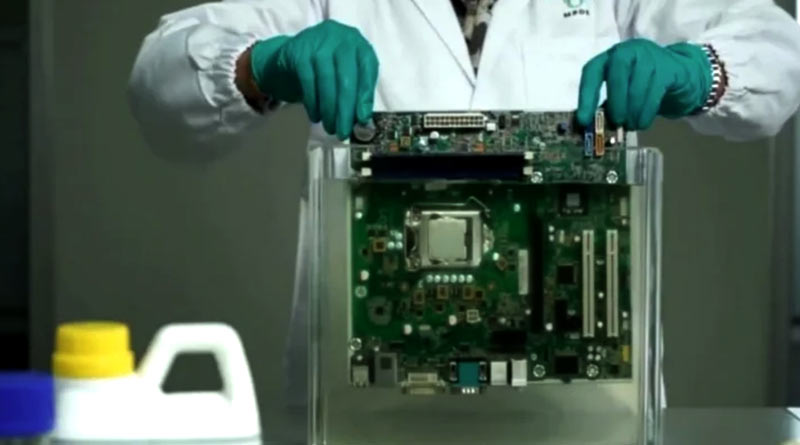
When it comes to keeping high-performance PCs cool, an all-in-one (AIO) liquid cooler is already a familiar sight. But the Malaysian Palm Oil Board (MPOB) is taking the concept quite a bit further with Sawit EcoTherm, a palm oil-based immersion cooling fluid designed to cool entire servers rather than just their processors.
Developed by MPOB’s Advanced Oleochemical Technology Division, Sawit EcoTherm is a non-conductive dielectric fluid made from locally sourced palm-derived materials. The technology is aimed primarily at data centres, where increasingly powerful AI hardware is generating significantly more heat and placing greater demands on cooling infrastructure.

Turning Data Centre Cooling Water-Free
Dr Noor Khairin Mohd, senior research officer at the division’s process engineering and design unit, said conventional water-based cooling systems could consume an estimated 876 million litres of water every day across Malaysia’s data centre industry. That is equivalent to the daily water needs of nearly four million people, highlighting the potential strain that continued data centre expansion could place on the country’s water resources.
Sawit EcoTherm instead uses a closed-loop immersion cooling system, where server components are fully submerged in the non-conductive fluid. Rather than relying on cooling towers that lose substantial amounts of water through evaporation, the fluid continuously absorbs heat from the hardware before circulating it away. “If widely adopted, immersion cooling with Sawit EcoTherm could significantly reduce the water demand of the data centre industry,” Noor Khairin said in comments reported by Bernama.
The approach is particularly suited to AI and hyperscale data centres because AI servers can generate three to five times more heat than conventional servers. By directly cooling the components, immersion cooling can accommodate higher heat loads while allowing greater computing density and potentially improving both efficiency and reliability.

Up To 50% Lower Cooling Energy
On top of water conservation, MPOB says Sawit EcoTherm can also reduce the amount of electricity required for cooling. Directly cooling server components eliminates the need for conventional server fans and can reduce energy consumption by around 30% to 50%, contributing to improved power usage effectiveness (PUE).
Lower electricity consumption also means lower indirect, or Scope 2, greenhouse gas emissions for data centre operators. MPOB positions the technology as addressing several sustainability priorities at once, including water conservation, energy efficiency, carbon emissions reduction and environmental protection.
The fluid is produced using up to 95% renewable, bio-based palm-derived materials, reducing reliance on petroleum-based alternatives. It is also PFAS-free, readily biodegradable and has low ecological toxicity, which MPOB says could reduce environmental risks associated with leaks or disposal. For context, PFAS (or per- and polyfluoroalkyl substances) are a group of highly persistent chemicals commonly referred to as “forever chemicals” because of their resistance to natural breakdown.

MPOB Wants Industry To Put It To The Test
Despite its potential, Sawit EcoTherm will still need to prove itself in real-world data centre environments before it can be widely adopted. Noor Khairin said government support and collaboration across the industry will be important in establishing the ecosystem needed to commercialise the technology.
This includes cooperation between MPOB, technology providers, data centre developers, server manufacturers and immersion cooling system integrators. Pilot projects, technical validation and demonstrations will also be needed to establish confidence in the fluid’s performance, reliability and long-term cost benefits.
With Malaysia’s booming data centre industry, MPOB believes the technology could eventually help the country establish itself as a global leader in sustainable immersion cooling. Its use of locally sourced palm-derived materials could also give Malaysia a distinctive advantage in developing the technology.
And who knows? If the technology proves feasible, perhaps one day we’ll see an AIO variation of Sawit EcoTherm for personal PCs as well.